
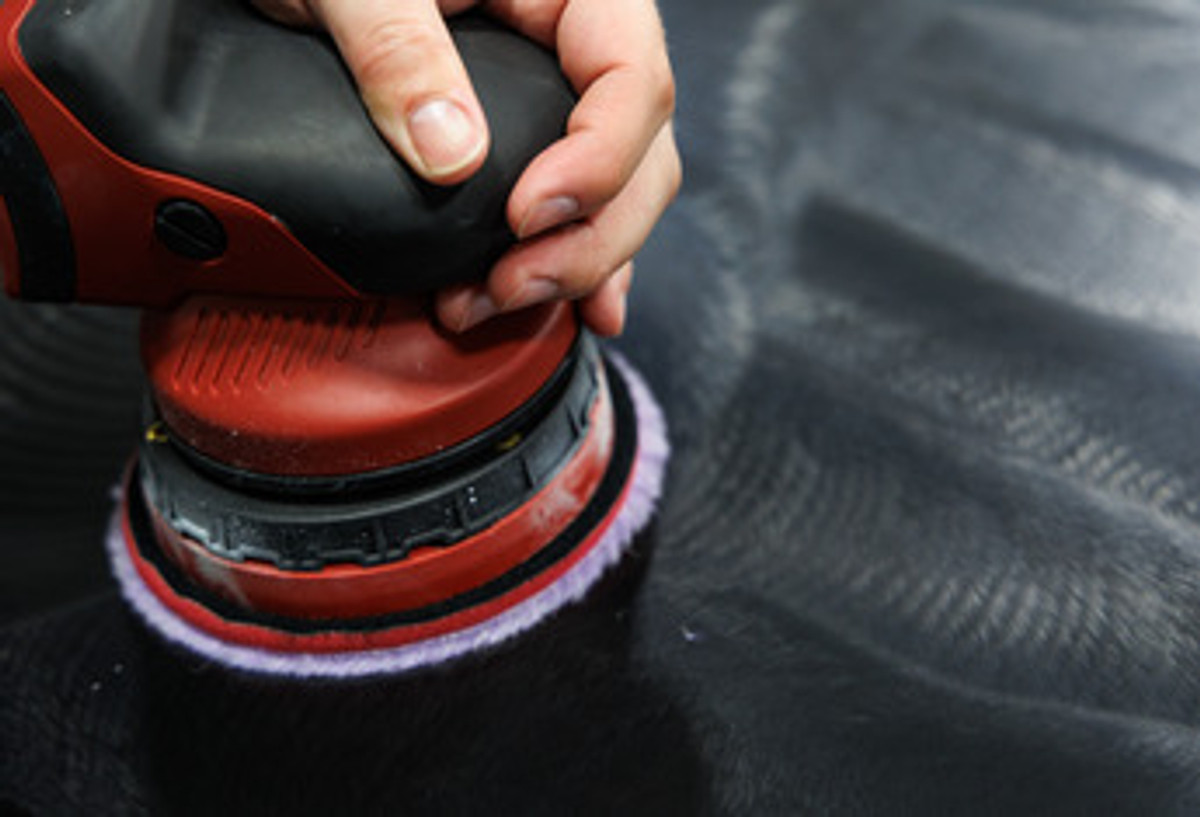
  This simple step-by-step guide will explain how to use
your circular polisher to remove paint imperfections and rapidly improve the
quality of your finish. Keep in mind,
circular polishers
offer complete removal of scratches and swirls, but there is a learning curve.
If you are inexperienced with machine polishing, start with a
dual action
polisher and become familiar with the process. Once you become comfortable,
graduate to the circular polisher.
What is a circular polisher?
A
circular polisher
is sometimes referred to as a rotary or high-speed polisher. It’s called
“circular” because the head spins on one axis. It spins typically from 600-3000
RPMs. This single motion allows a
circular polisher
to level the clear coat that surrounds a scratch so that the scratch’s “edges”
disappear. Professionals who want to completely remove a deep scratch must use a
circular polisher.
| The heat is on! Circular
polishers get much hotter than dual action polishers because the pad is
spinning at a high speed. You MUST keep a circular polisher moving at all
times so this heat doesn’t concentrate on one spot. It will burn through the
paint in seconds. You can minimize the
risk by practicing on scrap car panels before you attempt any work on your
own vehicle. You can pick up old parts at your local junk yard for a fee,
but it’s definitely cheaper than repainting your vehicle!
Popular models of circular polishers are the
FLEX
LK603VVB Circular Polisher and
L403
VRG Lightweight Circular Polisher, the
Makita 9227C, and the
DeWalt 849. |
A Few Facts about Clearcoat
So you may understand the thickness of clear coat, think of the cellophane
wrapper on a pack of cigarettes. Remove it and press the two sides together.
This thickness represents the depth of clear coat that protects your vehicle's
pigment layer. The outer surface of the clear coat is the “hardest” and
“densest” and is impregnated with the critical UV protection. This surface -
assaulted by bugs, bird droppings and acid rain - gets worn away revealing the
softer, underlying clear coat. This makes clear coat "fixable", meaning swirls
and scratches can be removed with a polisher.
The Paint Facts - Typical Industry Paint Thickness
Specs.
E-Coat 1.3 mil - Electrocoat is an anticorrosion coat applied to both
sides of the steel to prevent corrosion (rust).
Surface Primer 0.7 mil - Initial protection layer with texture to assist
the pigment layer in bonding to the metal beneath.
Base Coat 0.6 mil The basecoat is usually 0.5 to 1 mil thick (1,000 mils
equal one inch).
Clear Coat 1.9 mil - The clearcoat provides gloss for that "wet look,"
plus physical protection from the elements, including ultraviolet rays. The
clear coat is usually between 1.5 and 2 mils thick.
As you can see, the clear coat is very thin. So, while you
can polish out scratches, you must use great care with a circular polisher to
avoid burning the paint.
Polishing Tips
- First and foremost, keep the polisher moving at all
times. Never let a circular polisher rest on the paint. It will burn through
the clear coat.
- Work at a slow speed, between 1000-1200 RPM. A circular
polisher is capable of getting very hot, especially at high speeds. While a
little heat can make the clear coat more malleable, too much will burn the
paint. Keep it slow.
- Work the pad flat against the paint or with the back
edge of the pad tilted very slightly upward (that's the edge closest to you).
This position will help you avoid dragging the edge on the paint, which
creates holograms or what some detailers call "cookie-cutting".
What problems can a circular polisher
correct?
A circular polisher can remove almost any scratches or
swirls and most oxidation, as long as they do not penetrate beneath the clear
coat. A good way of assessing a scratch is to run your fingernail over it. If
your fingernail catches in the scratch; that generally means it is too deep to
be removed without professional help. Scratches and swirls that extend through
to the color coat will require repainting or a touch-up at the very least. Do
not attempt to remove these scratches because you can remove the entire clear
coat, resulting in paint system failure.
That said, many detailers enjoy the high speed performance and quick paint correction of a circular/rotary polisher. All it takes is practice and a steady hand to master the art of machine polishing.
|